 Horses and Ponies shares knowledge, experience and the love of equines on the lifelong path of improving horsemanship.

How to Clean a Horse Sheath - A Must Do Job for Better Health Eliminating Pain and Discomfort Cleanliness in any form is a good thing. Keeping your horses sheath clean and free of beans is a very … [Read More...]
How to Pick Up a Horse Hoof
 By Jeffrey Rolo
The idea of picking up a horse’s hooves can intimidate some owners since a well-placed horse kick would really hurt!
Such caution is good, but in reality if you pick up a horse’s hoof properly you provide him with no leverage or ability to kick you.
This is a situation where a person’s worst fears can cause him to imagine an incident that is highly unlikely to occur with careful handling.
Here’s how to safely pick up a horse’s hoof:
Starting with the front hoof, approach your horse diagonally from his front so that he clearly knows you are there – you don’t want to surprise him. Place yourself even with his shoulder and make sure to face his rear; you will both be facing opposite directions during the hoof picking process.
Making sure that your feet aren’t too close to the horse’s hoof, start running the hand parallel to him down his shoulder and along the length of his leg, finally stopping just above his ankle. Gently grasp the ankle portion and click (or otherwise verbally cue him) to ask him to raise his leg. If he’s well trained, that small cue will be more than enough and he’ll do just what you requested. You’re now free to begin picking his hoof.
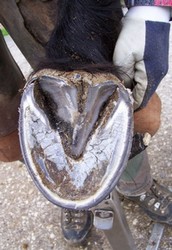
Lifting a horse's foot
Provide Physical and Verbal Cues
If your horse is being a bit stubborn or hasn’t learned how to pick up his legs yet try leaning into his shoulder as you run your hand down the back of his cannon bone. You can also gently squeeze/pinch the tendons to further cue him to what you would like. As you perform these physical cues make sure you provide a verbal one also (I make a clicking sound) so the horse later associates your sound with the requested response. Increase the weight you push against his shoulder until he finally lifts his leg as requested.
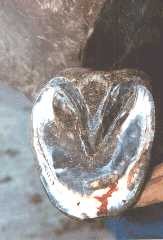
When picking a horse’s hoof you want to remove all debris from the hoof clefts as well as the rim and frog. Be careful around the frog because it can sometimes be a bit sensitive, particularly if the horse has thrush.
Once you have finished cleaning the front hoof carefully guide it back to the floor; you don’t want to allow the horse to slam it, potentially hitting your foot in the process. Praise your horse and pat him on the front shoulder a bit so he understands that you are pleased with his cooperation, then run your hand along his back to his rear leg. Place yourself in the same position as you did with his front leg and do the process over again.
There is a slight difference between lifting a rear foot and front foot, even though your basic positioning and actions are nearly identical. When you lift your horse’s rear foot he will probably give a little jerk that you might misinterpret as a kick. This is a common reflex reaction among horses and nothing for you to worry about.
Secondly, when you raise your horse’s rear leg you’ll want to step into him a bit so that your hip is underneath his leg. Rest his leg on your thigh, grab his hoof and gently flex it upwards. By doing this you lend him some support and more importantly the position of his leg and his flexed hoof will prevent him from being able to kick you.
Clean the hoof, lower it cautiously as you did the first and praise him. Congratulations – you’re halfway done! The opposite side will be done exactly the same way, but try to return to his front and start the opposite side rather than move around his rear. It’s bad practice to approach or circle all but the most trusted horses via the rear in such close quarters since a horse would be within range to strike.
Even Balance is Important
When lifting any hoof try to make sure your horse is properly squared (balanced evenly on all four legs) so that when you lift one hoof he can easily balance on his remaining three. At no time should the horse actually lean his weight on you! Even when you rest his rear leg on your thigh you’re not allowing him to use you as a crutch.
Once you have picked your horse’s hooves a few times it will probably become very simple and take less than 5 minutes to clear all hooves. Most trained horses will raise their hoof for you the moment they feel your leg run down their leg.
It is a very good idea to control your horse’s head while you are picking his hooves. This can be done by attaching his halter to crossties or asking a partner hold your horse’s head. By controlling his head you ensure your horse can’t move away from you while you’re trying to pick his hooves, or worse… turn around and take a bite at your rear!
Source: The above article originally appeared on AlphaHorse, a website dedicated to horses and the owners who love them. You will find many other informational articles dealing with horse training, horse care and more on their site.