 Horses and Ponies shares knowledge, experience and the love of equines on the lifelong path of improving horsemanship.
How to Clean a Horse Sheath - A Must Do Job for Better Health Eliminating Pain and Discomfort Cleanliness in any form is a good thing. Keeping your horses sheath clean and free of beans is a very … [Read More...]
First Lessons
Every Horse is Different
One of the reasons it’s so hard to write about training horses is that everyone wants a recipe. Do this, then that, then this other thing. Use such and such equipment, do so and so exercises a certain number of times. Follow the right steps and you’re guaranteed a trained horse.
The problem is that the main ingredients in the recipe–the horse and the handler–are never the same. Horses have different personalities. People have different personalities. Even the same horse and the same handler can be different from day to day. So the only way a recipe can work is if a particular handler has enough common sense to adapt the recipe to where a particular horse is on a particular day.
I’ll use a baby green horse getting his first lessons about responding to pressures as an example. My first training goal is to create a feeling of rhythm and relaxation in the horse by keeping his attention quietly on me as I move and breathe with rhythm and relaxation. I like to turn an uninitiated horse loose in an enclosed area. I put a drop noseband or something similar on the horse to stabilize his jaw so that the game of nipping or mouthing me just never even gets started. I like pens with corners because I can use the corners to teach the horse turning and stopping pressures more easily. The size doesn’t matter just so it’s not too small. So I start by turning him loose in a pen he’s never seen before.oh hello!
One kind of horse will just want to investigate and I just let him. After he’s had a chance to investigate for awhile, he’ll start being aware of things going on occasionally but not continuously. Eventually, he’ll stop to smell a place. Without being predatory or attacking him in any way, I’ll just make as little a fuss as I have to get his attention and I put some pressure on him to keep walking. My goal is to get his attention in the quietest, most comfortable way. I want him to be aware of my presence in the pen. But I don’t want to startle him or build any emotional charge in him at all.
Now another kind of horse won’t follow that recipe. He goes into that same pen the first time all charged up to start with and feels like he needs to run. So I’ll turn him loose and just stand in the middle of the pen and watch him play until he gets rid of his energy drive. If he gets all hot and sweaty that first time, I’ll just wait until he’ll allow me to approach him then I’ll catch him and put him away. If I think a horse is going to run so much that he’s going to be hard to catch, I may leave the lead rope hooked to his halter. Stepping on the lead rope interrupts his feeling of total freedom to escape. This doesn’t work on some really smart horses that learn to carry their head to the side so the rope trails beside them and they don’t step on it. But it works for most.
If he just plays a little and doesn’t get all sweaty and worked up, I’ll wait until he stops acting up so much, slows down to a walk. At that point I circle behind him and start following him on his primary line (the line of attention that runs from the horse’s ears to his tail and out the front and back as far as he’s aware of it). I don’t use any kind of predatory posture. I don’t swing anything at him.
I just walk along behind him on that primary line and experiment with his attention at this step. If I move to the left of the primary line, he should move his head to the left so he can continue to see me as he’s walking along. If I move to the right of the primary line, he should move his head to the right a little bit.
If my presence behind him startles him so he starts running again, I got too close. If the horse doesn’t interact with me in any way, I know I’m too far behind his primary line. My presence isn’t putting any pressure on him at all. So I walk a little faster to shorten the distance between us and increase the pressure. I don’t move up in any kind of a predatory way. I’m not chasing him or hunting him. I move up as though I’m watching the birds or enjoying the weather. I don’t want to force the horse to pay attention to me. I just want to develop his awareness of me. The more he becomes aware of me, the more he’ll check back with me and the more control I’ll start to get over every individual stride. That’s my goal.
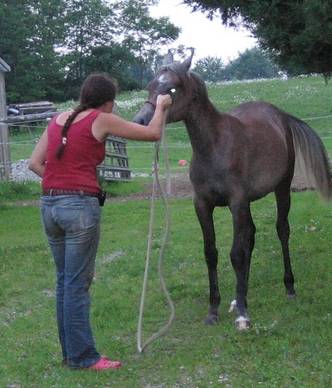
Teaching an Arabian Filly Ground Manners
More than likely what the horse will do as he gets more and more comfortable with my presence is that he’ll approach the gate and look out the direction he came from. Now he’s at the same point as the first type of green horse and now I’m going to make the first little fuss to ask him to keep walking.
Just as with the more laid back horse we talked about first, I don’t want to do anything that startles the horse or changes his emotional level. I want to make as little a fuss as it takes to get his attention back on me. I may bump the wall or make a little noise or slap my thigh or wiggle the tip of a whip or put a little sway in a lead rope. I’ll experiment and use the least pressure I can. Every horse has its own personality and its own instincts and its own previous memories. So the pressure that one horse doesn’t notice at all might make another horse flee the county. So I start quiet and small and build up if I have to. I see what it takes to get the horse to go back to a casual walk and look mode. If I were to do something huge and sudden in order to make the point that I’m bigger and badder and I can get the horse moving again if I want, I would have lost an opportunity to figure out how to subtly influence that particular horse. That’s another goal at this stage.
So I can tell you what the goals are at this point but I can’t give you a recipe for exactly what things you should do to reach them. I can tell you that what worked the first day might not work the second day. I can tell you that as the horse learns to become aware of you and understands that your pressures are a language he can learn and be rewarded for learning that you’ll have a huge sense of accomplishment. It’s going to look really boring to somebody watching you but you and the horse are going to know exactly what’s going on.
I can also tell you that horses are patternistic. If you teach a horse that every time you take him into the pen he’s going to get to run and play, he’s going to start to anticipate that. You’ll teach him that every time he sees you, he gets to explode. Instead, you want him to start anticipating that any interaction he has with you is relaxed and rhythmic. You want him to see you as a safe, comfortable place to be so you want to develop a relaxed, rhythmic pattern to your workouts that the horse can become familiar with and be comfortable with.
by Ron Meredith
Dr. Meredith has over thirty years experience as president of Meredith Manor International Equestrian Centre and has developed it from its humble beginning of six students in 1963 to its current world class level. Because of his outstanding contributions to the horse industry and specifically to equestrian education he has received a number of distinctive recognitions. One of the most significant is an Honorary Doctorate of Equestrian Studies Degree from Salem College in 1981, the only degree of this kind in the world. Dr. Meredith has held seven AHSA judges cards and has trained top level horses and riders in the cutting and reining world.
© 1997-2013 Meredith Manor International Equestrian Centre. All rights reserved.