 Horses and Ponies shares knowledge, experience and the love of equines on the lifelong path of improving horsemanship.

How to Clean a Horse Sheath - A Must Do Job for Better Health Eliminating Pain and Discomfort Cleanliness in any form is a good thing. Keeping your horses sheath clean and free of beans is a very … [Read More...]
How to Bridle and Unbridle a Horse
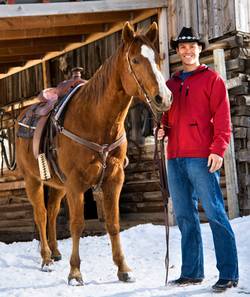
Owner with saddled and bridled horse.
~ Putting on (and taking off) a Horse’s Bridle ~
by Adrianne Lake
Placing a bridle on a horse may look easy – and it is when you know how. But this basic task can still be unbelievably daunting to the novice rider.
In this article I try to simplify the task of bridling and unbridling a horse, breaking it down into logical phases that should help you focus and understand the process.
This is one of those things that you may need to be shown more than once before you gain confidence in your ability to bridle (and unbridle) a horse or pony.
Learning to Put on the Bridle
As always, make sure the horse is in cross ties or tied with a quick-release knot. If you have not done this before, it would be wise to ask for assistance until you feel comfortable with this process.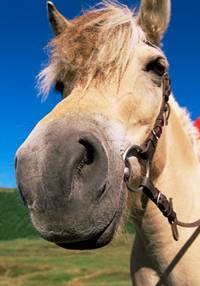
Phase One: The halter.
You will need to undo the halter and slide it down under his nose, and loop the crown over his head to the animal is somewhat tied while you bridle.
Phase Two: Inserting the bit.
With your left hand, grasp the bridle over the bridge of the nose keeping the bit near the horse’s mouth. With your right hand holding the bit, place your thumb into the back corner of the animal’s mouth. The horse should open it’s mouth, pull the bridle up and slide the bit into place behind the teeth. Take care when doing this — the mouth is a very sensitive area of the horse’s body.
Phase Three: Place the bridle correctly.
Now pull the bridle over the ears (you may want to do this one ear at a time) so that the crown fits behind the ears. Take care not to poke the horse in the eye.
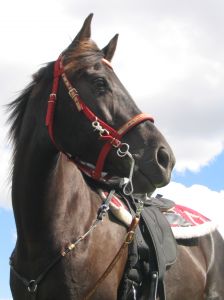 Phase Four: Fasten all the buckles.
Do up the throatlatch — you should have about three or four fingers clearance between the strap and the horse’s throat. Now do up the chin strap keeping two fingers width clearance between the strap and the chin. If you are using a curb bit, you will need to fasten the curbstrap which should have more slack in it than when using a snaffle bit. Make sure the bridle itself is not too tight or too loose.
Phase Five: Finishing touches.
Slip the halter off the horse’s neck. Take a look and see if the mane or forelock is tidy.
Unbridling:
Put the halter on the horse as you did when you first putting the bridle on. When the horse is secure, undo all the buckles and straps. Gently pull the crown of the bridle forward over the horse’s ears. Slowly pull the bridle down and off being careful not to knock the horse’s teeth with the bit. Put the halter back on.