 Horses and Ponies shares knowledge, experience and the love of equines on the lifelong path of improving horsemanship.
How to Clean a Horse Sheath - A Must Do Job for Better Health Eliminating Pain and Discomfort Cleanliness in any form is a good thing. Keeping your horses sheath clean and free of beans is a very … [Read More...]
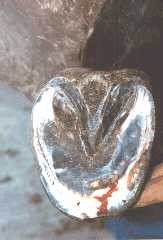
Lower Leg Lameness and Injury
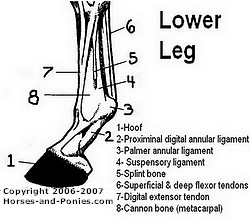
Parts of the lower leg of a horse
~ Information on Lower Leg Injuries and Lameness: ~
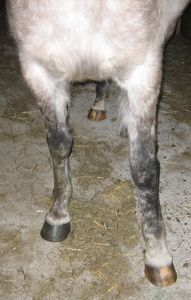
Many lameness issues of the equine occur in the lower leg below the knee. Below this area the anatomical structure of the leg is the same in forelegs and hindlegs. Most lameness occurs in the forelimbs because 65% — 70% of the horses weight is carried by the front legs. The healing process below the knee or hock is slow due to the lack of blood supply to the tissue and bone (there is no muscle on the lower legs of a horse). Lameness problems from the fetlock down are usually caused by excessive concussion to the area, conformation faults, or both. It is important not to push your horse too fast with intense training (especially a young horse) and remember to take the time to warm up and cool down properly. Be aware of when your horse is tired. If you have any doubts about your horse’s condition or what to do call your veterinarian.
Bowed Tendon: This condition can be mild or severe, yet all bowed tendons should be treated as an emergency. Ligaments and tendons are located at the back of the cannon bone and when the deep flexor tendor and/or the superficial tendon becomes strained or ruptured and the area becomes swollen this is known as a bowed tendon. They are caused by excessive stretching, training and fatigue of the tendons, external damage or long pasterns. Often seen in race horses. Some horses with bowed tendons will be become sound again, but the tendon will be prone to re-injury. Chronic cases will have permanent scar tissue. Treatment: Lower leg treatments to relieve inflammation/pain and rest for three – twelve months.
Bucked Shins: This condition is seen often in race horses undergoing intense training. Bucked shins is caused by strain and excessive concussion (overtraining on hard ground) and is usually seen in young horses. The front of the cannon bone becomes sore and inflamed. This is an acute coniditon that can become chronic if not dealt with efficiently. Treatment: Controlled exercise and lower leg treatments to relieve the inflammation/pain.
Brushing: This injury occurs often when riding and sometimes when a horse is in a paddock or field. The inside edge of the hoof clips the fetlock of the opposite leg. This can be caused be poor conformation, fatique, poor coordination or bucking and running hard when let outside after being stabled. The easiest way to prevent this is to fit your horse with brushing boots when riding or turning out. Treatment: Farrier might trim and rasp the offending hoof to cause less damage. Focus on balance when riding. Let the horse out more so it calms down. Treat the wound itself accordingly (ie antibiotic ointment).
Check Ligament Desmitis (sprain): The check ligament is found behind the upper part of the cannon bone sandwiched between the bone and the deep flexor tendon. The horse may or may not be lame. This injury is caused by a strain or sprain to the area is difficult to determine because of the depth of the ligament. Treatment: Lower leg treatment to relieve pain/inflammation. Rest for a number of months. Re-think the training regime.
Cross Firing: This is when a part of the hind hoof clips the inside of the opposite forefoot which can cause a wound. Bad conformation is a factor in this (“toe out” in front hooves and “toe in” in hind hooves). This is seen a lot in racers, particularly pacers. Treatment: Clean and dress wound accordingly. Corrective shoeing. Use of bell boots for protection (don’t put boots on current wound).
Curb: Curbs are common in young horses. It refers to a rupture or strain of the plantar ligament which is located behind the hock. The swelling is visible about four inches below the hock joint and is usually firm when pressed. When healed, the swelling may remain or reduce in size. Initially the curb may be slightly warm and the horse slightly lame, but more often the horse shows no signs of lameness. Curbs can be caused by poor conformation (sickle or cow hocks), kicking hard walls or excessive bucking, jumping and galloping. Treatment: Lower leg treatments to reduce inflammation/pain and rest until healed.
Filled or Swollen Legs: This is commonly seen in horses that spend the day in the stable and especially standing stalls. From the knee or hock down, the legs fill with fluid and look puffy. It is usually noticed in the morning, and the swelling goes away when the horse is let out or exercised. As mentioned above, horses have poor circulation in their lower legs and when they are not moving even poorer circulation because of decreased heart rate. This causes the legs to fill with fluid. Also the lack of muscle movement causes lymph to stagnate in the lower leg. Treatment: Filled legs is not a serious condition yet it is a sign that your horse needs more turnout time and perhaps less grain.
Osselets: This refers to pain and inflammation that occurs above or below the front of the fetlock. Osselets is caused by strain and is seen often in young racehorses. Pain is eveident when the fetlock is bent and hard swelling might be visible. Treatment: Rest. Corrective shoeing, controll exercise and slow training regime. Lower leg treatments to relieve inflammation/pain.
Over-Reach: The heel and/or coronary area of a foreleg is hit by a hind hoof causing a wound or tearing off a shoe. This can be caused by bad shoeing, conformation faults, fatigue and poor coordination/balance. Treatment: Clean and treat wound accordingly. Over-reach or bell boots can be fitted on the front feet to prevent future injuries (but do not put these boots over a current wound). Correct trimming/shoeing, and focus on balance when riding.
Ringbone: New bone growth occurring below the fetlock. Low ringbone refers to calcification of the lower, short pastern bone or the coffin bone (lower phalanx 2 and/or upper phalanx 3). High ringbone refers to calcification of the long pastern bone or higher short pastern bone (phalanx 1 and/or upper phalanx 3). Articular ringbone is calcification within the joint itself. If the ringbone is below the coronary band it cannot be seen, yet if it is above a bony growth will be evident. Some horses with ringbone recover quite well and lead a usefull life. Initially their will be heat, lameness and swelling. Ringbone is thought to be caused by poor conformation (long or short pasterns), and repetitive concussion to the area. Treatment: Rest and lower leg treatments to relieve inflammation/pain. Confirm that any calcium/phosphorus imbalance in the diet is not a factor.
Sesamoiditis: At the back of the fetlock is two sesamoid bones. Sesamoiditis occurs when these bones are damaged or inflamed. Acute lameness is generally present and the fetlock will swell. Long pasterns and repetative concussion to the area is the usual cause. This is a serious condition and the horse will need to be immobilized. Treatment: Long rest period (12 monthes). Pain relief and lower leg treatments.
Splints: Splints are very common and are usually not serious. A splint is a hard and bony swelling on either side of the cannon bone. Generally occurs in young horses. Initially splints are warm and painful, but become hard, cold and painless when healed (although they do leave a blemish). Strenuous play or work on hard ground/repetitive concussion causes splints. Treatment: Anti-inflammatory lotion, a little rest and more conservative training.
Suspensory Ligament Desmitis (sprain): This injury is the same as a bowed tendon except that a ligament is strained or ruptured–not a tendon. Ligaments have less elasticity than tendons and can therefore be injured easily. The suspensory ligament is located behind the cannon bone beneath the flexor tendons and connects to the sesamoid bones. This condition is caused by excessive strain on the area and can be aggravated by poor conformation. Treatment: Lower leg treatments to relieve inflammation/pain, and rest.