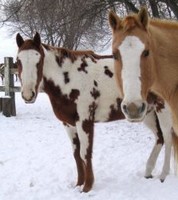
Two paint horses
All about Paint and Pinto Horses
by Adrianne Lake
Description and Characteristics of the Paint/Pinto Horse:
Paints and Pintos are horses that contain two distinct coat colours, normally with the addition of some white. They usually stand between 14.2 HH and 15.2 HH, yet ponies and draft horses are often part coloured. These horses are typically sturdy and reliable, but due to a wide range of conformation types are used for many different things. While the body type of these horses greatly varies, paints and pintos generally have good conformation. Paints and pintos have similar markings, yet they have two separate registries. Every paint or pinto animal has a coat pattern unique unto itself.
In England, part coloured horses are referred to as either a piebald (black and white) or a skewbald (white and any other colour). In North America, the colour patterns are defined as overo, tobiano, and tovero.
Overo:
An overo has a white face and irregular or scattered body markings. The tail is of only one colour. Horses of this coat pattern can be mostly dark or mostly white, but the white will not cross the back of the animal. One or all four of the limbs will be dark coloured and blue or china eyes are usually present.
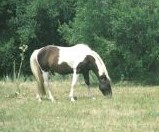 Tobiano:
These horses have solid face markings and a tail of two colours. A tobiano can be either predominantly white or dark yet it will display dark patches on at least one flank. Often all four limbs are white. The tobiano’s colour splotches are large and distinct.
Tovero:
This colour class was created for horses whose coats display both tobiano and overo characteristics. They often have blue eyes, spots on the chest or flanks, and dark colours on the ears, mouth and forehead.
Breed History:
These coloured horses originated in the United States. It is thought they are descended from horses that were introduced by the Spanish conquistadors. Paints and pinto were highly prized among the Native Americans as they thought these horses possessed magical powers. The Comanche Indians especially treasured the Paint. Numerous Comanche hides have been found displaying part-coloured horses. Herds of wild horses containing many pintos populated the Western plains by the early 1800’s.
While originally being simply a colour breed, recent efforts have been made to produce different types of part coloured horses. The Pinto Horse Association of America (PTHA) was founded in the 1950’s and recognizes any part coloured horse. This was the beginning of the preservation of this unique coat pattern. The PTHA’s horses are divided into hunter, pleasure, saddle and stock types. The PTHA also registers coloured ponies. In 1962 a different group formed to preserve both the colour and stock conformation type of these horses called the American Paint Stock Horse Association (APSHA).
Another registry altogether is the American Paint Horse Association (APHA). It is currently the second largest registry in North America. The APHA only accepts coloured horses that have thoroughbred, quarter horse or paint bloodlines.
Adrianne Lake Copyright © 2007 horses-and-ponies.com